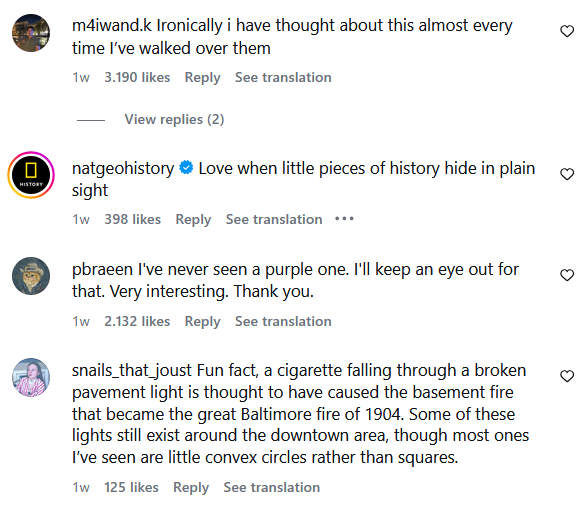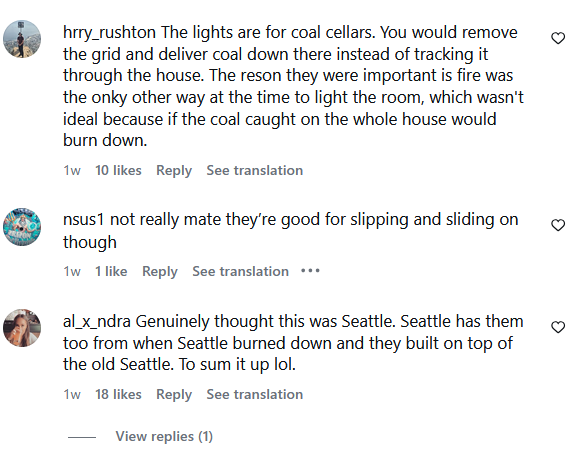




Woman Goes Viral For Revealing What Those Little Glass Squares On Sidewalks Are Actually For
A woman has gone viral in a recent video while explaining what those strange little glass squares on some sidewalks are for, which you can find in tons of different cities across the globe.
In her post, which garnered over a million views on Instagram in the last couple of weeks, she explains that these odd features were originally installed in the late 19th and early 20th centuries, and were meant to provide natural light in underground places before the use of electricity.
The video was shared by Anya Hooper, known on social media as Anya Through Time, who is a British history and English student, volunteer archivist and content creator who focuses on social history, women’s history, genealogy and heritage.
Hooper describes herself as an amateur genealogist and a heritage enthusiast, and her content from her history account has gone viral multiple times for sharing fun facts like this.
In Hooper’s latest viral video, she goes over the peculiar feature of rows of little glass squares that can be seen on different sidewalks around the world. In her post, she explains when they were installed and what they are for.
@anyathroughtime Did you know this? There's plenty of pavement lights all around London, they are a great slice of the city's forgotten history. I'm always scared I'm going to fall through them for some reason! As electric light became more accessible, pavement lights were almost completely phased out by the mid 20th century. #historytok #london #victorian ♬ original sound – Lossless
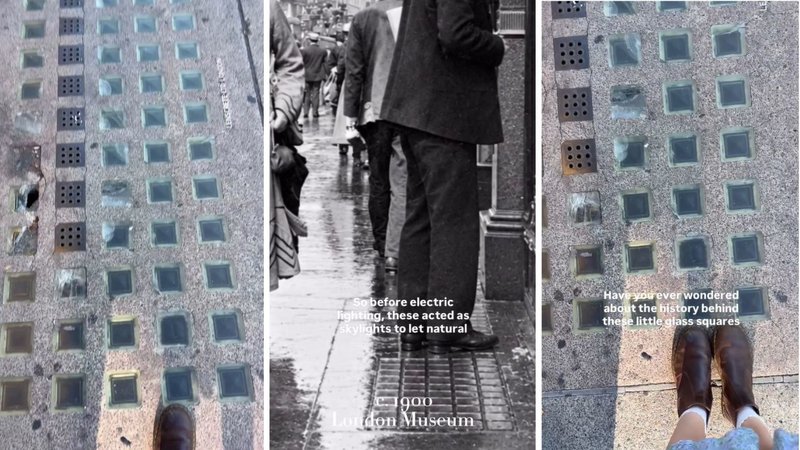
Hooper's video begins with her filming a London sidewalk, which has a section with rows of these little glass blocks embedded in the cement. "Have you ever wondered about the history behind these little glass squares on the side of the pavement?" she asks in voiceover.
"Well, I'm Anya," she says, turning the camera onto herself, "and I'm here to tell you they are called pavement lights."
"And most of the ones you see are likely Victorian or early 20th century," Hooper continues, showing a black-and-white photo taken around the year 1900.
The photo shows people walking on a London sidewalk, dressed in Victorian attire, and Hooper zooms into a section where the pavement lights can be seen.
"So, before electric lighting, these acted as skylights to let natural daylight into underground cellars, vaults, shop basements and often bars and clubs too," she explains, showing another black-and-white photo, this time from 1902, which depicts two people looking at pavement lights.
Then, the video goes back to Hooper as she films her feet walking on some pavement lights in current-day London.
"But the glass used in the 19th century contained manganese," she says, showing a chart with information about said element, "which was used as a clarifying agent to remove the greenish hue caused by iron."
"And when exposed to UV light, over time, the manganese oxidises, and it creates this beautiful purple colour," she explains, showing a photo of purple colored pavement lights. "So, if you ever see a purple pavement light, just know that it's pretty old," Hooper concludes.
In the comment section of the post, various users wrote other interesting facts about pavement lights they knew, including history facts about them in other cities, while others expressed that they'd always wondered what their function was.